

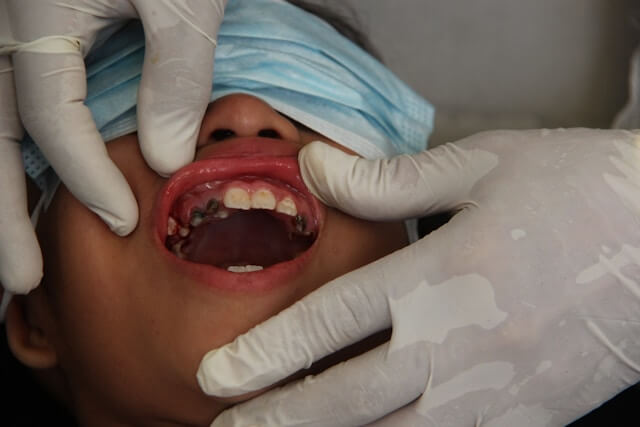
The formation of cavities in milk teeth is one of the common causes of worry among parents, especially mothers. It is also the commonest reason children experience toothache.
According to the centre for disease control, by age 2 to 5 years, more than one in 10 children has had at least one tooth decay in their primary tooth.
What Is a Milk Tooth?
Milk teeth or primary teeth are the first set of teeth that appear in the mouth of a child. They begin to appear when the baby is up to 6 months of age. Milk tooth eruption could be earlier or later than age 6 months in some children.
There are 10 primary teeth on each jaw making up 20 milk teeth altogether in the mouth.
There are two jaws in the mouth (upper and lower jaws). Each jaw contains the following primary teeth: two central incisors, two lateral incisors, two canines, two first premolar and two second premolar.
Milk teeth are easily susceptible to tooth decay (dental cavities) because they are not as strong as the permanent successors.
Does Tooth Decay Fill Up on Its own?
Dental cavities whether in the primary or permanent teeth, do not fill up on their own. This is contrary to what people think. Once there is cavitation due to an ongoing decay process, the cavity cannot fill up by natural process. It can only take the intervention of a dentist to restore the tooth.
However, if one practices dietary control and good oral hygiene, the decay process can stop progressing. This does not in any way suggest you should not take your child to the dentist. If you notice that your child has tooth decay, take him to the nearest dental facility for proper treatment.
Early Childhood Caries
The presence of one or more tooth decay, filled or missing tooth as a result of dental caries in a child not more than 71 months of age is what is known as early Childhood Caries.
Tooth decay in children 5 years or younger is one of the most common childhood diseases.
Ignorance on the part of the parents among other factors is one reason for development of cavities in milk teeth. Every parent should be able to identify dental cavities in milk teeth and also ensure their kids access care as soon as possible.
How to Identify Cavities in Milk Teeth
If you do not know what dental cavities look like, you may not be able to help your kids. Here are a few features that will help you identify cavities in milk teeth.
1. Presence of a White Spot on the Enamel
Tooth decay is a process that doesn’t just start as frank cavities whether it is milk or permanent teeth. When tooth decay sets in, it usually begins as a white spot on the enamel.
This white spot indicates that the enamel on that part has been weakened. If the process of decay is allowed to continue, the white spot with time will give way for an actual cavity.
2. Brown or Dark Cavities on the Enamel
When the cavity first forms, it usually appears brown in colour. As it progresses, it can become darker. A dark and hard cavity could indicate that the decay has halted.
3. Presence of Pain
For some people pain is the wake up call that makes them notice there is a dental cavity. Pain occurs If the dental cavities progress without treatment and involve the pulp of milk teeth..
Progressive dental cavities can lead to loss of milk teeth. It’s important to note that premature loss of milk teeth can lead to poor dentition when the permanent teeth begin to erupt.
Causes of Tooth Decay in Milk Teeth
The causes of cavities in milk teeth are the same as the causes of tooth decay in permanent teeth. For tooth decay to occur, there must be sufficient interaction between caries-causing bacteria and refined sugar on a tooth surface. Teeth that are more at risk are usually the molars with deep pits and fissures to retain food substances long enough for bacteria to act on them.
Risk Factors of Tooth Decay in Milk Tooth
Although tooth decay occurs as a result of interaction between certain bacteria in the mouth and refined sugar, certain factors can put your kids at risk of developing dental caries. They include the following:
1. High Sugar Diet
Foods and drinks that are rich in refined sugar carry a high risk for cavities to occur, especially in milk teeth. The milk teeth are not as strong as the permanent ones. That is why children who feed regularly on a high sugar diet can easily come down with dental caries.
2. Prolonged Bottle Feeding
Bottle feeding is common among babies and toddlers as it offers a lot of advantages. However, some studies have shown that children who sleep while bottle feeding are at risk of developing dental caries. A study conducted in Australia showed that children who bottle feed to sleep beyond one year stand a higher risk of developing milk teeth cavities.
3. Insufficient Fluoride Exposure
Fluoride is important for strengthening the enamel and helping to prevent dental cavities both in milk teeth and permanent teeth.
Any child who does not get adequate fluoride either from water, food or toothpaste is at risk of dental caries. Your child’s dentist may decide to do a fluoride therapy if your child has cavities in milk teeth. He can also do a fluoride therapy if he suspects that your child is not getting enough fluoride. It is important you take your child for a regular dental check up.
4. Poor Oral Hygiene
Children snack a lot. Many of the snacks children take have the potential to cause dental caries. Children who don’t brush regularly are even more at risk of developing dental cavities. Poor brushing allows food remnants to stay long enough in the mouth for bacteria to act on them. Teach your children to brush at night before bedtime. It is a routine that will help prevent cavities in the milk and permanent teeth.
The accumulation of plaque and calculus provides an enabling environment for caries causing bacteria to grow and thrive. If you notice a build up of plaque and calculus on your children’s teeth, quickly take them to see a dentist for professional teeth cleaning.
Conclusion
Cavities in milk teeth is a serious problem. If untreated, it can lead to pain, gum swelling, difficulty in eating, and poor sleep. Tooth decay is preventable. Ensure your child sees a dentist at least twice a year. This helps early detection and treatment of dental caries. Do not wait until there is a problem before taking your child to a dentist.